The history of manufacturer of watches and jewelry Knoll & Pregizer began in 1887 in Pforzheim, Germany, founded by Theodor Eberhard Friedrich Knoll (1851-1928) and Friedrich Pregizer (1882-1961). Knoll & Pregizer created jewelry from 1887 to 1975.
Each Knoll & Pregizer creation is a handcrafted sterling silver piece using the finest paste, imitation of diamonds, rubies, sapphires and emeralds. Sometimes KP jewelers used semi-precious stones such as amethyst and onyx. The maker’s mark on the reverse traditionally includes the crossed letters K and P. Knoll & Pregizer designs are inspired by Edwardian, French Belle Époque and Art Deco. (more…)
Many-awarded Spanish jewelry designer Josep Maria Puig Doria (1926 – 2006) started making jewelry in 1948. Located on Avenida Diagonal in his native Barcelona, his company became a trendsetter in brutalist jewelry with modernist touches, as well as in costume jewelry. Since the mid 1960s he received the international reputation, and his jewelry business went uphill.
Although Puig Doria designed and made jewellery himself, he also relied on independent talented craftsmen to develop the design and embody it in metal. In general, this was understandable, because the growing demand for his jewelry led to an expansion of production and an increase in the administrative burden on the founder of the company. Initially, the company’s craftsmen created jewelry from silver, metal, ebony, and even from egg shells to create mosaics.
In 1971, Puig Doria developed a line of economical silver jewelry for export to the United States and West Germany under the Puig Doria brand. Puig Doria sold his jewelry in the world’s most famous showrooms, such as Saks Fifth Avenue, Bloomingdale’s, and Van Cleef & Arpels. Seven years later Puig Doria opened his namesake store in Geneva, and in 1984 in Japan.
Today, the second and third generation of Puig Doria jewelers continue the family business, creating exclusive jewelry from precious metals and stones. (more…)
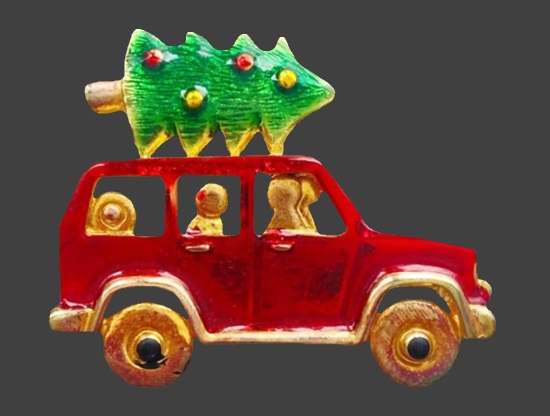
Christmas tree on red truck car gold tone enamel brooch pin. Douglas Paquette Vintage Costume Jewelry
The history of Douglas Paquette, Inc., also doing business as Douglas Paquette Accessories began in 1976 in Providence, Rhode Island. The company’s president was Douglas A. Paquette, who began the business as a hair ornament company. The firm later produced a variety of accessories and jewelry, from interchangeable belt buckles and keychains to dog collars and costume jewelry.
According to Jewelers’ Circular-keystone (1990), Douglas Paquette Accessories moved to 112 Frank Mossberg Dr., Attleboro, Massachusetts. The firm supplied high-quality jewelry and accessories to women’s specialty stores. Over its fifty years of operation, the company went through changes, mergers, opening of subsidiaries in Connecticut, Massachusetts, and their closures. The last Paquette Accessories boutique in Mystic, Connecticut closed for good in 2024.
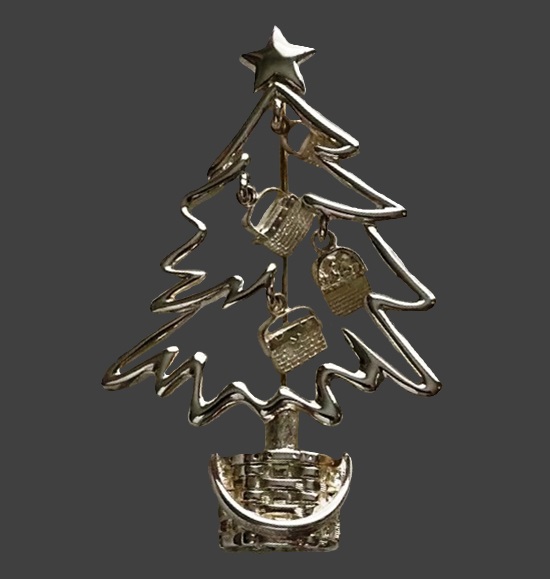
The Providence-based jewelry studio handcrafted jewelry from the finest materials—gold, silver, metal alloys, crystals, and enamels. Notably, in the late 1990s, Douglas Paquette produced a line of costume jewelry for the famous Longaberger basket company. One of their brooches, a Christmas tree with basket charms, was featured in Nancy E. Trowbridge’s book, O Christmas Tree.
One of the trademarks launched by the company in the 1990s was Elite by Douglas Paquette. The earliest maker’s mark includes “Paquette” and a copyright symbol on an oval or rectangle cartouche. Since 1990s maker’s mark included stylized
“Douglas Paquette” in script on a papyrus scroll or paper scroll cartouche.
One of the brands launched by the company in the 1990s was “Elite by Douglas Paquette”. The maker’s mark trademark originally included “Paquette” and a copyright symbol on an oval or rectangular cartouche. However, since the 1990s, the marking has changed to a stylized “Douglas Paquette” on a papyrus or paper scroll cartouche. (more…)
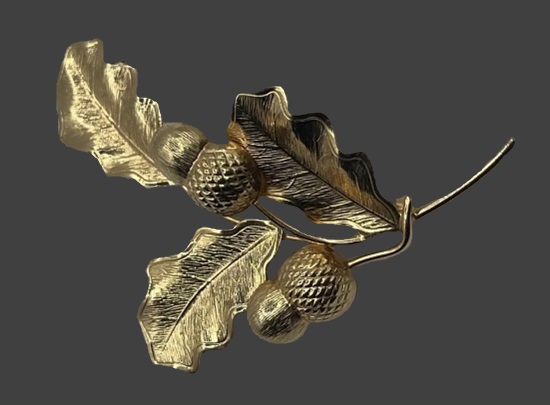
Oak leaves and acorns 12 K gold filled brooch pin. Signed R Inc Rolyn Inc Vintage Costume Jewelry
The history of R Inc trademark on manufacture of women’s jewelry began in Cranston Rhode Island in 1961. It was the first of the seven trademarks launched by Rolyn Inc. company owned by Anthony Rendine (1929-1993) and his son Anthony Andrew Rendin Jr. Among other trademarks are Chante, C’Est Bien, Giana Leesa, Kobe (1984), and Opalite.
According to the 1961 ad in Jewelers’ Circular Keystone, Rolyn Inc. were manufacturers of a complete line of ornamental findings in gold-filled, sterling silver, karat- gold and brass for the jewelry trades. Also, the company had a representative HY Franc on 392 Fifth Avenue, New York.
Tge range of R Inc jewelry pieces demonstrate classic style handcrafted necklaces, brooches, bracelets, earrings, and pendants. Leaf and floral design circle pins, figural brooches, carved ivory flowers, filigree swirls and curls. The maker’s mark includes Inc” inside a letter “R”.
Cornucopia design gold tone pave rhinestone brooch. Courreges Paris Vintage Costume Jewelry
French fashion costume jewelry brand Courreges Paris began its history in 1980 which lasted 25 years. The owner of the brand was the Courreges Design Limited Company, located at 40 Rue Francois ler Paris France. Initially, Courreges bijoux was part of fashion shows and perfume presentations of the iconic Parisian fashion house André Courrèges.
One of the greatest French fashion designers, Andre Courrèges (March 9, 1923 – January 8, 2016) was an innovator, creator of futuristic “space age” fashion, perfumer and jewelry designer. Courrèges created clothing sketches from childhood and dreamed of becoming a designer. Later, Cristobal Balenciaga, for whom Andre had worked for 10 years and considered his teacher, helped him create the Courrèges haute couture house in 1961.
The master jewelers created high-quality bijoux using gold plating, Swarovski crystals, rhinestones, enamel, and faux pearls. Noteworthy, the earliest jewelry pieces had “Courreges Paris” mark on an oval cartouche (1980-2004), while later ones had a stylized AC mark.
Designed by Don Paquette for the Longaberger basket company. Featured in Nancy Y. Trowbridge’s book ‘O Christmas Tree’. Longaberger Vintage Costume Jewelry
The history of the costume jewelry brand Longaberger began in 1991 and lasted for a little over ten years. The owner of the costume jewelry trademark was Longaberger Licensing, LLC, headquartered on Broadway, New York, USA. The company produced accessories, home decor items and jewelry under license from the famous Longaberger Company.
A characteristic feature of the jewelry design marked Longaberger was a wicker basket, which harmoniously fit into the style of jewelry. For example, a Christmas tree brooch, decorated not with Christmas tree balls and toys, but with miniature gilded baskets. Or a figural brooch in the form of a bear with a basket, a Thanksgiving brooch in the form of a basket with a harvest, etc. Noteworthy, famous designers and jewelry companies created jewelry for the company of David Longaberger. In this case, jewelry had a double marking, for example J.J. and Longaberger.
Founded by David Longaberger in January 1973 in Dresden, Ohio, the family-owned company made the hand-woven maple baskets that made the company famous around the world. With multimillion-dollar revenues and several thousand employees, the company made not only wicker baskets but also home and lifestyle products.
The company’s popularity peaked in the 1990s, and perhaps the crowning glory of the company’s popularity was its office, a monument to its greatness. The largest basket in the world, and also the 7-story corporate headquarters of the Longaberger company, built in December 1997. One of the main tourist attractions in Newark, Ohio, USA, the office is an example of unique architectural design. In 2013, Longaberger was acquired by CVSL, Inc. and closed in 2018. (more…)
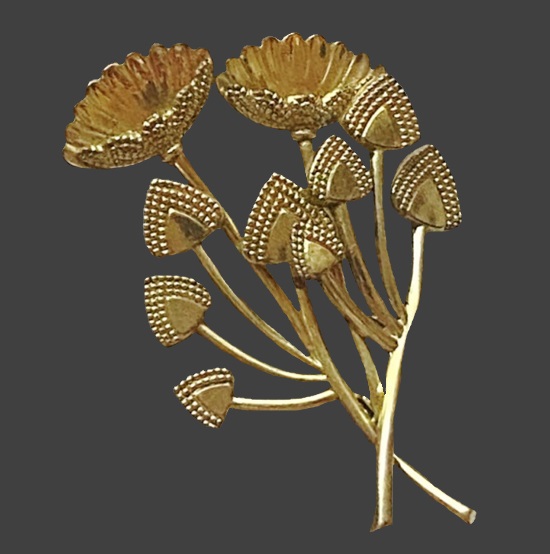
The history of the costume jewelry brand Floralia began in 1960 in the jewelry capital of Germany, the city of Pforzheim. Floralia was one of the brands owned by Rodi & Wienenberger AG, founded by Eugen Rodi and Wilhelm Wienenberger in 1885.
The peak of popularity of the Floralia jewelry came in the 1960s, when the brand’s products adorned many fashion and lifestyle magazines in Germany and abroad. Among them, in particular, Stern, Frendin, Constanze, Quick, Burda Mode, and even The Australian Women’s Weekly (1966). On all advertising posters next to the Floralia brand the company logo is depicted – RoWi with an anchor.
Among other well known trademarks of RoWi were Elasto-Fixo, Fixo-Flex and Admira. When creating jewelry, the company’s craftsmen used solid gold, silver, Austrian crystals and faux pearls. The jewelry design traditionally included plant motifs – leaves, flowers, which corresponds to the name of the brand. Crafted with great skill and standing the test of time, Floralia jewelry is now a collector’s item.
Once a thriving company with multi-million dollar profits and thousands of employees, Rodi & Wienenberger filed for bankruptcy in 2010 and ceased operations in January 2019. (more…)