Costume Jewelry Designer Nettie Rosenstein
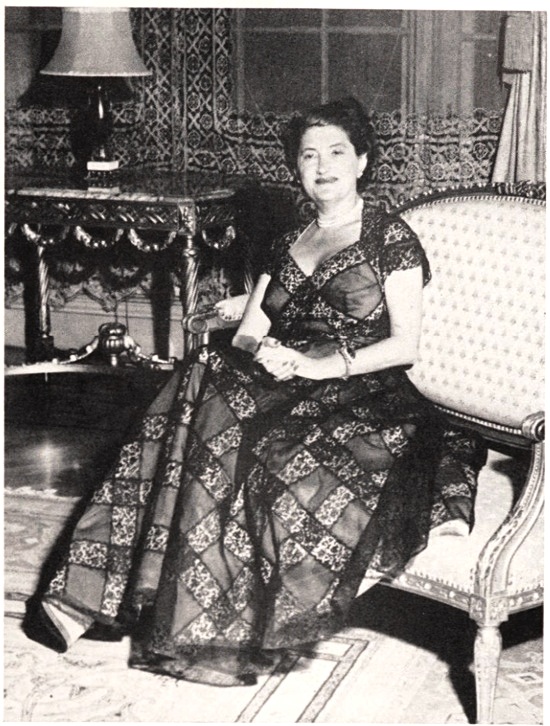
The most famous American designer of the 1930-50s, Nettie Rosenstein (née Rosenscrans) was the first to receive the Neiman Marcus Fashion Award in 1938. In 1940, her clothes were sold in 92 stores across America, with prices ranging from $98 to $500. Her designs were more expensive than those of any other American designer.
In 1942, Nattie Rosenstein (1890 – 1980) began creating limited edition jewelry from sterling silver and vermeil, popular in the 1940s. She also used rhinestones, plastic (imitating coral, bone, and turquoise), ebony, imitation pearls, and enamel. The designs were quite varied, featuring flowers, insects, leaves, animals, Asian and African motifs, and heraldry.

Nettie Rosenstein’s father was Joseph Joseph Rosencrans, a former wine merchant from Salzburg, Austria. He came to New York City in 1893 with his wife and three children, Alvin, Pauline, and Nettie. He opened a dry goods store on 118th Street. Pauline, the eldest daughter, loved to make hats, and by 1910, Madame Pauline was running a hat business in the Rosencrans family home, next to the dry goods store.

Childhood
Nettie, who was three years old when she came to America, spent her childhood running errands and picking up thread for her sister. However, her favorite time was in her father’s shop, stretching pieces of fabric or collecting scraps and pieces to take home and sew.

Marriage
One night in 1912, a girl she knew brought Saul Rosenstein to her house. Saul Rosenstein was a quiet young man who had a successful business selling women’s underwear. When Nettie Rosencrans played the violin for him, he listened with admiration. A year later, in 1913, Saul and Nettie were married.
After their wedding, the Rosensteins moved to West 141st Street, and a year later, to a ground-floor apartment in a townhouse on West 117th Street. There, Mrs. Rosenstein, who had always sewn her own clothes, began making dresses for her friends as well. Eventually, she opened her first dressmaking shop.

Success in business
Mrs. Rosenstein’s business, which began with a few seamstresses in a single room of the apartment she shared with her husband and young son Jerome, expanded, occupying first the second and then the third floors of the building. By 1921, she decided to move to a more fashionable building on East Fifty-sixth Street. By then, she employed fifty girls and also occupied the fourth, or top, floor.
Thanks to a customer who brought a customer from I. Magnin’s specialty stores in California, she first encountered wholesale. In 1940, her business at 36 West Forty-seventh Street employed 235 tailors, seamstresses, and cutters, producing between 10,000 and 13,000 dresses a year. Consequently, her gross income exceeded $1,000,000, and that figure has only grown since.

Manufacturing jewelry
In 1942, Rosenstein began manufacturing costume jewelry through the Nettie Rosenstein Accessories Corporation with offices at 680 Fifth Avenue, New York. She designed her first collection herself. The collection included metal and sterling brooches, pins, clips, earrings and bracelets with floral motifs.
In the 1960s, Nettie Rosenstein retired, and her long-term business partner and Coty Award Winner Saul L. Klein continued to design jewelry and accessories under the Nettie Rosenstein brand.
Her friends liked to recall how, during the fashionable season of junk jewelry, Nettie herself wore a single, narrow bracelet of small sapphires. Her critics, mainly artistes in the flash-and-flair business, thought such exquisite restraint indicated a lack of self-confidence. Upon learning of this, Mrs. Rosenstein, not given to flashy jewelry, laughed and said, “I guess I just like pretty things.”

Nettie Rosenstein Jewelry