Harry Pakula Jewelry Company History
Born in Russia, Harry S Pakula (1898-1981) immigrated to the United States as a teenager. After settling in Chicago, he began his career with local jewelry companies. Remarkably, the young and energetic Harry successfully built a career not only in jewelry but also in sports.
He was a leading player in the baseball league of the Chicago Jewelers’ Athletic Association, according to a 1917 publication in the Jewelers’ Circular.
Before founding his own company, Harry Pakula spent several years successfully working at the jewelry firm Alter & Co., rising to a management position. After gaining many years of experience in the jewelry business, establishing his own firm in 1932 was a logical step.

Moreover, by 1932, Harry already had a family – his wife, Harrietta (née Ross, 1897–1975), and a 9-year-old daughter, Marilyn. Harrietta subsequently became actively involved in the family business and accompanied Harry on his business trips both within the country and abroad.

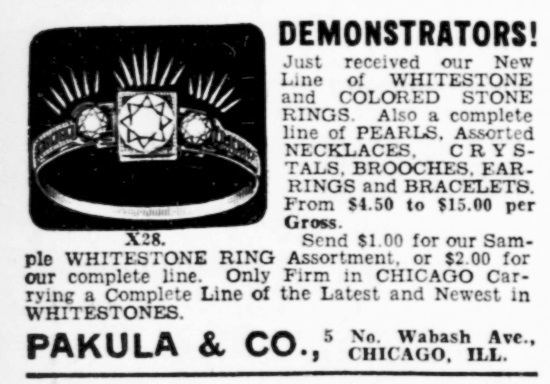
Initially, the company was known as Harry Pakula & Co, 5 Wabash Ave, Chicago. They manufactured and sold jewelry souvenirs and a full line of jewelry — rings, necklaces, bracelets, earrings, brooches, and pendants. According to the ads, the company’s craftsmen traditionally used multicolored stones, crystals, and pearls.

Incorporated in 1939 with a capital stock of $10,000 and a par value of $100 per share, the company became known as Pakula & Co, 5 Wabash Avenue, Chicago, Illinois. Harry Pakula served as president and treasurer, and Harriett Pakula served as vice-president and secretary. The same year Pakula opened its office at 303 Fifth Ave, New York.
Advertising Campaign

From the very first days, Pakula launched an extensive advertising campaign to promote its products and recruit staff. Pakula’s advertising most frequently appeared in The Billboard magazine, from 1933 to 1950. As a result, the business expanded. Harry Pakula opened the first branch of the firm in Texas in 1936, and later – divisions in New Yok and Providence.
Meanwhile, Pakula’s advertising campaign attracted the attention of the US Federal Trade Commission in 1948. The commission ruled that Pakula should no longer use the words “birthstone,” “emerald,” “ruby,” “sapphire,” “amethyst,” or similar words that refer to natural stones—in its advertising. Thus, Pakula was using only imitation gemstones.

In 1950, Pakula, along with two other major Chicago jewelry retailers, sponsored Jewelry Training Service of Chicago. It was a nonprofit jewelry school that offered training in precious metalworking. Students learned to create exquisite jewelry from precious metals and stones. Milton Axelrad, vice-president of Pakula & Co, served as the school’s treasurer, and later – president.

Important Executives and Managers
Among the most important executives of the Pakula company was Milton S Axelrad (1916 – 2008). He was the husband of the founder’s daughter, Marilyn Pakula (1923 – 2006). Since 1950 Milton S Axelrad led Pakula & Co as vice-president.
Other sales representatives and managers included Mark Reznek, Robert Crosswhite, Hugh Campbell Lyon, Henry Strimpel, Al Raymond, Jules Brandel, Richard First, Howard Ucko, and Genevieve Loeb.
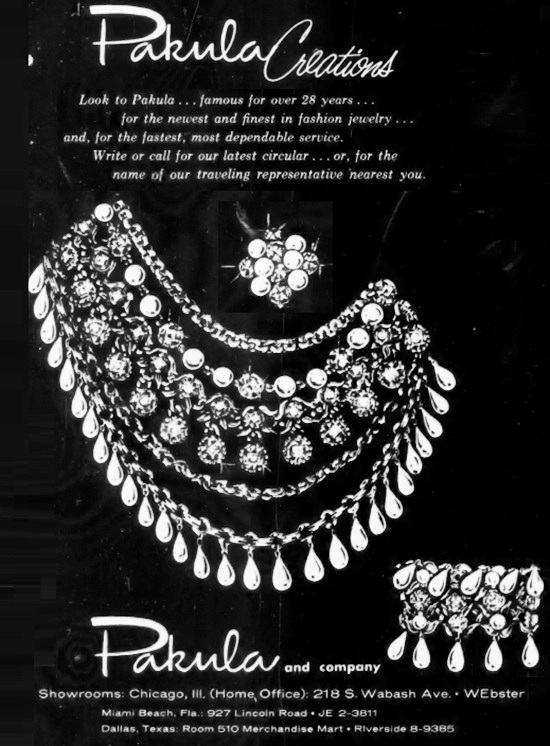
Noteworthy, Pakula regularly participated in national and foreign jewelry fairs and exhibits, including France and Germany.
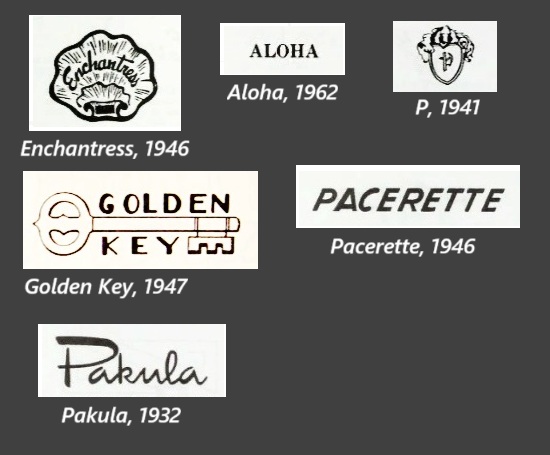
Jewelry Trademarks
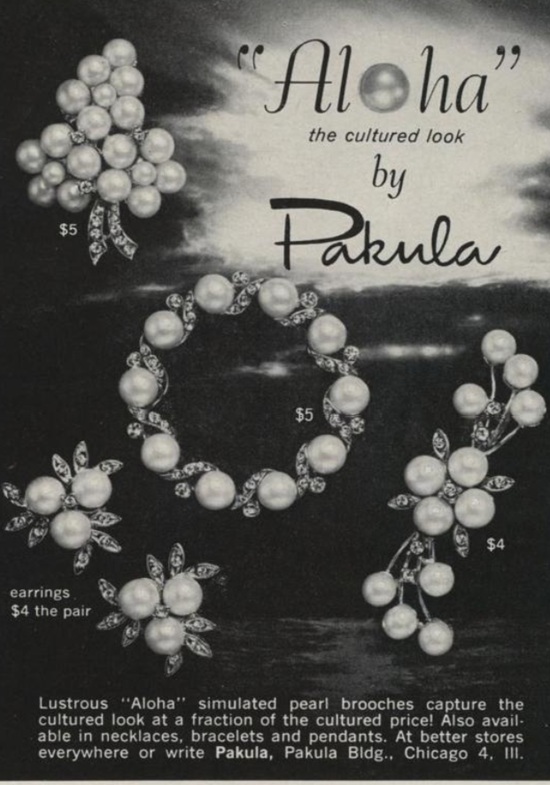
According to the Official Gazette of the United States Patent and Trademark Office, Pakula & Co registered tens of trademarks on manufacture of costume jewelry, novelties and lighters. Most notable of them are – Accents by Pakula; Celebration (Children’s jewelry and hair accessories), Golden Key, Aloha (pearl jewelry), Genevieve (Fashion jewelry), Golden Heritage, Hair Fair (Hair ornaments), and more.
Pakula & Co ceased to exist in 1993. Today, jewelry marked Pakula is highly collectible.

Vintage Jewelry and Ads