J. E. Caldwell Jewelry Company History
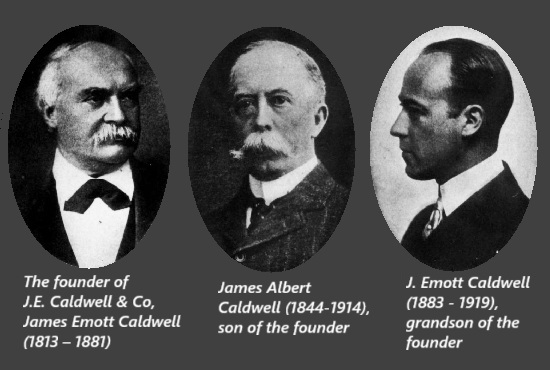
The history of the famous jewelry company J E Caldwell & Co began in 1839, when a young watchmaker James Emmot Caldwell (1813–1881) opened a small shop at 163 Chestnut Street, Philadelphia, Pennsylvania. From 1843 to 1847, Caldwell worked in partnership with James M. Bennett (d. 1847) in the firm of Bennett & Caldwell.
The young man did not have much capital, but he was honest and managed to establish connections with business people both in the country and abroad. First, he hung the motto “Service” in his office. Since then, this word has always been central to the founder, his son, grandchildren, and descendants.

From its small beginnings, by the late 19th century the company employed 370 people, and the total production space, including factories, was approximately 30,000 square feet. The jewelry factory was located at 918 Chestnut Street, and the stationery factory was on the corner of 9th and Walnut Streets.
Modern Store
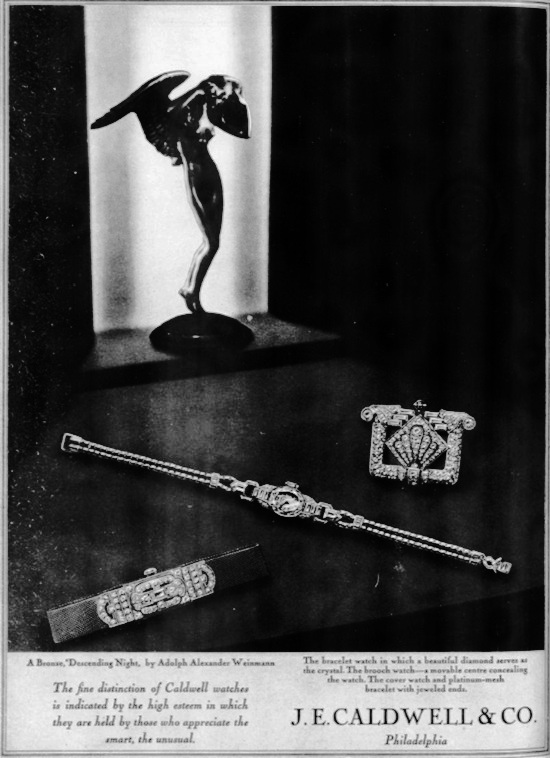
The magnificent modern store with its exquisite interior, J E Caldwell & Co, was often called the most beautiful store in the world. The spacious windows of J E Caldwell & Co. at 902 Chestnut Street traditionally attracted much attention of passersby. The main attraction in the east window was traditionally the art objects—exquisite dinner services, statues, bronze figures, and so on.
New Store Windows
James E Caldwell & Co sometimes displayed trophies, gold medals, silver penknives, and cigarette cases the firm created for various tournaments and events. Sometimes these were entire installations, demonstrating, for example the processes from start to finish of the making of a solid silver water pitcher.
Moreover, J E Caldwell & Co frequently hosted jewelry exhibitions, which attracted jewelers from out of town. For example, one such exhibition included a $25,000 silver service for the battleship Pennsylvania. The firm enjoyed a high reputation not only in Pennsylvania but also in other U.S. states.

J E Caldwell & Co was awarded a contract to make gold buttons for guests at Prince Henry’s reception in Philadelphia in 1902. These buttons became a beautiful souvenir of the occasion. They featured the city’s coat of arms in gold on a blue field, and on an enamel band was the gold inscription “His Royal Highness Prince Henry of Prussia.” Above the button was a gold crown.
Illusion jewelry
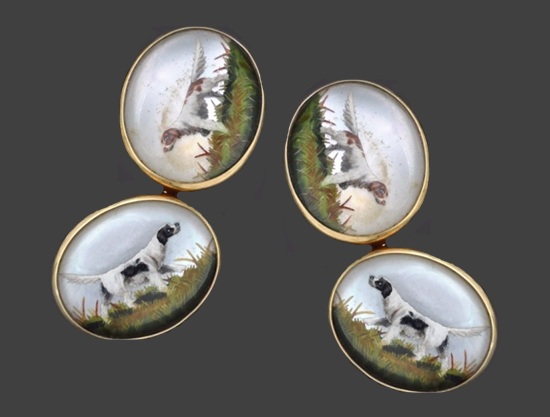
In 1912, the company introduced a sensational new product called “illusion jewelry.” This jewelry was a unique invention in the world of gemstone setting. The illusion consisted of a new way of setting the stones in a frame, which allowed the jewelry to take on a new color when viewed from a different angle.
Managing a company after the death of the founder
After the death of James E Caldwell in 1881, his son, James Albert Caldwell (1844-1914), took over the company. In turn, in 1914, his son and the founder’s grandson, J. Emmot Caldwell (d. 1919), continued the family business as president.

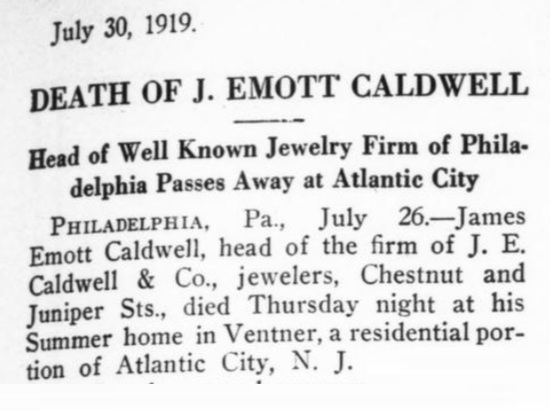
Following the death of J. Emmot Caldwell in 1919, his wife Frances and his business partner William R. Eisenhower took over the firm. Noteworthy, James Caldwell’s middle name is spelled differently in different sources. Furthermore, even within a single issue of the Jewelry Circular, the jeweler’s middle name is mentioned in different versions: Emott, Emmot, and Emmett. Also, different sources indicate the age of the deceased differently: 34 and 36 years.
Ralph S. Putnam, new president
According to the 1928 Jewelers’ Circular, the company’s president was Ralph S Putnam (d. 1935). Ralph began his career at Caldwell in 1882 and served as vice president from 1914.
In 1933 the company incorporated and Charles W. Oakford (1872 – 1956) became its president. He became chairman of the board 10 years later. Charles W Oakford entered the J E Caldwell & Co as a general partner in 1919.
In December 1939, J E Caldwell & Co celebrated its 100th anniversary. At that time, the company employed approximately 50 salespeople and more than 200 craftsmen, clerks, and managers. Four generations of the Caldwells had run the family business. Specifically, James Amott Caldwell, the founder, J. Albert Caldwell, a son; James Emott Caldwell, grandson; James Emott Caldwell, Jr., and J. Morton Caldwell, great-grandsons.
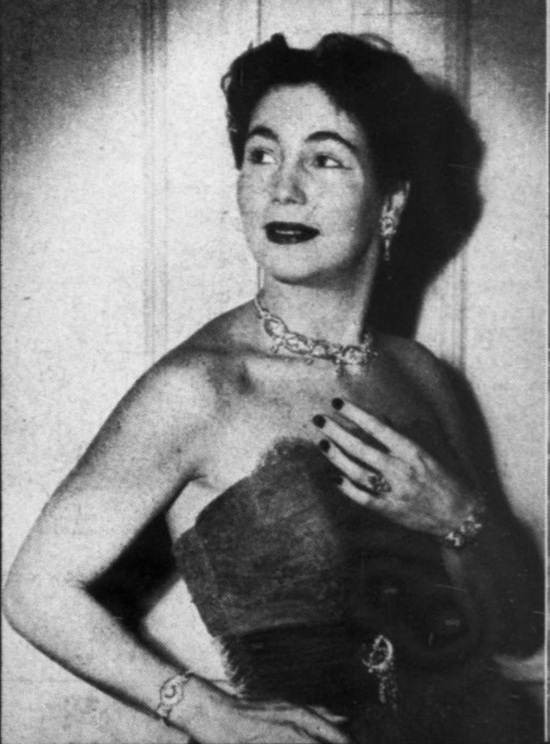
In 1952, Ostion Homer became the company’s president, with many plans for expansion. However, business declined, and the owners sold the company. The new owners were Henry Birks & Sons of Montreal, and in 1992, Carlyle & Co. of North Carolina. Subsequent attempts to revive the company were unsuccessful.