New York Jewelry Artist Marianne Ostier
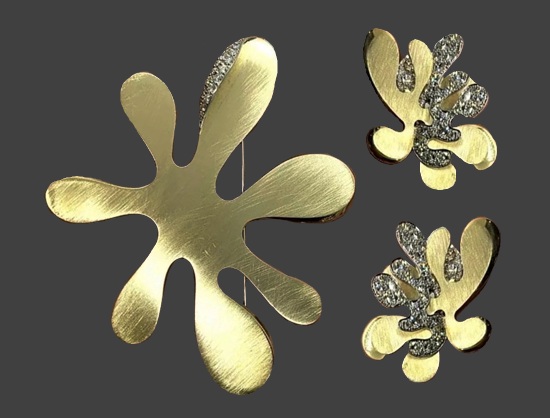
Diamonds were the best friend of Marianne Ostier (1902-1976), the only woman to receive the Diamonds U.S.A. award for outstanding design achievements in consecutive years. She also received repeated recognition for her work at the Diamonds International competition.
Born and trained as an artist in Vienna, Marianne married third-generation court jeweler Olivier Ostier (1901 – 1967). A trained sculptor, she devoted her considerable artistic talent to jewelry design.

Marianne Ostier created some of her most remarkable works for Queen Marie of Romania, Queen Geraldine of Albania, and other royals of Europe and India. Ostier did not limit her work to design alone. As a writer, she gained recognition with her 1958 book “Jewels and Women.”

She worked on commission for celebrities such as the former King Zog Albani, the Duchess of Windsor, and stars such as Hedy Lamarr and Marlene Dietrich. She also created jewelry for herself. Without $40,000 worth of rubies, diamonds, and other jewelry adorning her body, she felt practically naked.

Escape from Austria
She and her husband moved to America in 1939 and founded Ostier, USA Retail and manufacturing firm, 5 East 57 Street, New York. Within 10 years, they had a luxurious eight-room office at the top of Fifth Avenue and two large studios. But the Ostiers had to endure hell and storm before finding their fortune in America.
They fled Nazism from their native Vienna through German-occupied Albania. Then came France, England, Brazil and finally the United States. The American consul had been a client of Ostier’s while he held a post in Vienna, and he managed to turn the refugees into Americans.
Initially, Marianne sold her pieces on Fifth Avenue, increasing sales by 4%. She arranged an exhibition of her pieces at a leading jewelry house, and from there, her career took off. The Metropolitan Museum of Art acquired one of her designs—a gemstone angel—for its permanent collection.
Sculpture instead a sketch
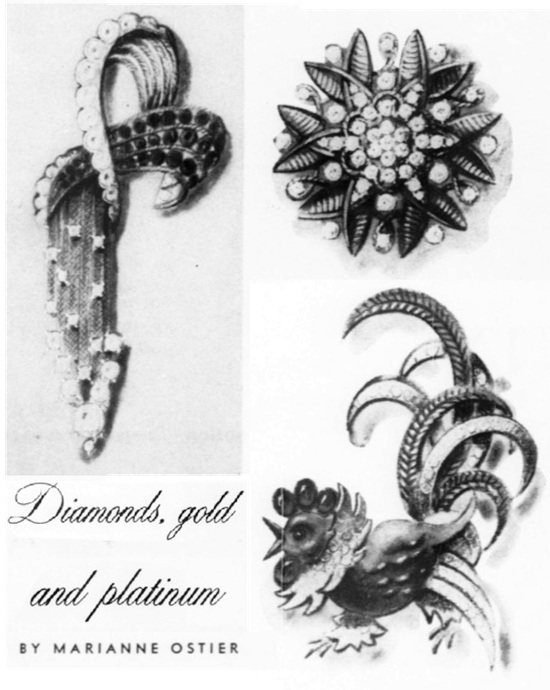
It was Marianne Ostier who introduced the world to sun-shaped pins and pincushions, which became so popular. Because most of her works relied on three-dimensionality, Ostier performed all the preliminary work using sculpture rather than sketches.
Her tools were copper and clay, with which she created full-size models of the pieces. She then embodied them in gold, platinum, and precious stones. Afterwards, she sent these models to the workshop, where experienced artisans, some of whom worked at the Ostier atelier in Vienna, created the finished jewelry.

Appearance and jewelry
When designing jewelry, she considered whether a particular piece would suit the woman wearing it. For example, she advised a woman with a round face to wear large clip-on earrings instead of long drop earrings. A slender woman should wear small clip-on earrings instead of heavy Victorian necklaces.
According to Marianne, a woman’s appearance can be completely transformed by the type of earrings she wears.
Moreover, she developed a chart showing which jewelry and makeup suited each skin type. Ostier also listed gemstones that complement different skin tones.
For example, she recommended aquamarines or emeralds for fair-skinned women. Rubies, diamonds, or topazes were more suitable for dark-skinned brunettes, and amethysts or sapphires for fair-skinned women with chestnut complexions.

Skin Pins
In 1951, department stores introduced several pins that attached to skin, and jewelers waited with bated breath to see the results. The new jewelry had several names—”Skin Pins,” “Cling Pins,” and “Magic Pins.” Marianne Ostier announced a secret process that allowed diamonds on a sponge base to be securely bonded to skin.
Ostier was proud that a film company made a film about it, making it the first time jewelry featured in a film.
Then news spread that some jewelry manufacturers had invented their own gluing methods. Accordingly, Ostier threatened legal action against unlicensed users of her device. She licensed the rights to manufacture such jewelry exclusively to Ralph Polcini’s Ledo brand.
However, other companies continued to make the jewelry, and customer interest (priced from $1 to $10) was brisk. Beads in the shapes of stars, sunbeams, butterflies, and hearts were sold with tubes of glue. They could be worn Hindu-style on the forehead, as earrings, on the ankle, or anywhere on the shoulder.
Ostier closed the business in 1969

In November 1961, the Ostiers opened their new salon in New York City at 5 E. 57th St. On September 26, a preview of the Ostier jewelry collection from 1962 was held. Following her husband’s death, Ostier closed the business in 1969. She sold the company’s remaining inventory at auction. Marianne Ostier died in 1976 at the age of 74.

Fine Jewelry by Ostier Inc