Renowned Danish Silversmith Georg Jensen

Renowned Danish Silversmith Georg Jensen. January 1952 Vogue ad
January 1952 Vogue ad. Renowned Danish Silversmith Georg Jensen

Born in the Danish village of Raadvad, Georg Jensen (1866 – 1935) was a prominent silversmith, artist, sculptor and ceramist. He graduated from a technical school and became an apprentice in 1884. He later attended the Royal Academy of Arts in Copenhagen and qualified as a sculptor in 1892.

In 1904, Georg Jensen opened his own workshop at Bredgade 36 in Copenhagen, taking with him one apprentice, Henry Pilstrup. The equipment in the workshop was very primitive. There were no machines. All work, including drilling holes, they did by hand.

(more…)

Danish Jewelry Designer Arne Johansen

Danish Jewelry Designer Arne Johansen
Modernist sterling silver pendant. Danish Jewelry Designer Arne Johansen

Danish jewelry designer and silversmith Arne Johansen (1927 – 2004) studied jewellery making with goldsmith Henry Andersen for three years. During his training, he demonstrated excellent craftsmanship and design talent. As a result, upon completing his studies in January 1951, he received the silver medal for his diploma work from the Danish Craftsmen’s Association.

He began his career as a jeweller at the renowned Danish company A. Dragsted. Founded in Bredgade (Copenhagen) in 1854, the company was known as the court jeweller and court goldsmith.
(more…)

David-Andersen Enameled Silver Jewelry

David-Andersen Enameled Silver Jewelry
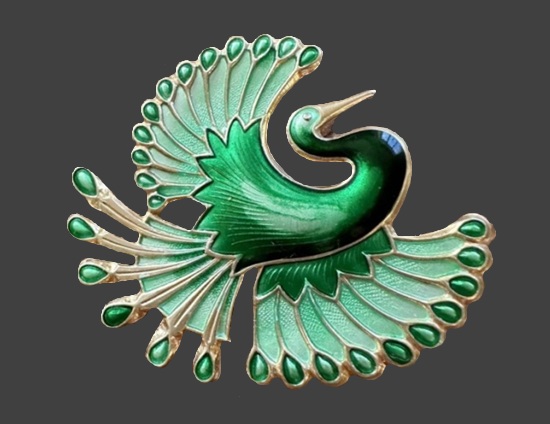
Bird sterling silver guilloche enamel brooch. David-Andersen Enameled Silver Jewelry

The iconic Norwegian jewelry brand, David Andersen is also the name of the founder of a silver manufacturing company known since 1876. Andersen studied jewelry making with a well-known Norwegian goldsmith Jacob Ulrich Holfeldt Tostrup (1806 – 1890).

The earliest mention of David Andersen (1843 – 1901) in the Jewelers’ Circular dates back to June 21, 1893. According to the publication, the most conspicuous feature of his jewelry was in the line of transparent enamels. Andersen had in his display great many silver articles decorated in remarkably beautiful vari-colored plique-a-jour enamels.
(more…)

Modernist Jewelry Designer Francisco Rebajes

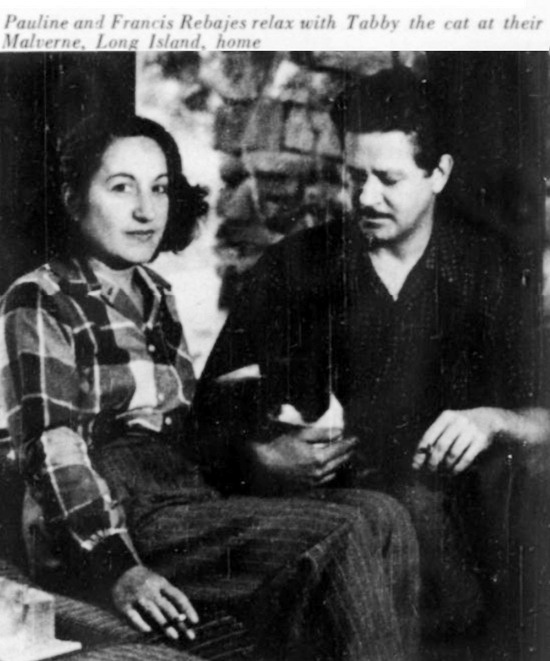
Modernist jewelry designer Francisco Rebajes met his wife, Pauline Schwartz, at a party in Greenwich Village during the darkest days of the Great Depression. It was love at first sight
He met his wife, Pauline Schwartz, at a party in Greenwich Village during the darkest days of the Great Depression. It was love at first sight. Americas, May 1953 photo. Modernist jewelry designer Francisco Rebajes

Born in the Dominican Republic, Francisco Torres Rebajes (1906 – 1990) was one of six children of shoe maker Antonio Torres Ros and Francisca Rebajes de Torres. He came to New York in 1923 to try his luck.

His first jobs were as a janitor, then as a grocery delivery boy, where he was fired for shoplifting. In the late twenties, the unemployed Rebajes moved to Harlem, where he slept on Harlem rooftops and in penthouse lobbies, earning his living doing odd jobs.
(more…)

Heintz Bros Jewelry Company History

Heintz Bros Jewelry Company History (1875 - 1925)
Lion head brooch pendant. 18 K gold, diamonds, emeralds, ruby. Heintz Bros Jewelry Company History (1875 – 1925)

The history of Heintz Bros jewelry manufacturing business began in 1875 founded by Charles F. Heintz (1845 – 1916) in Buffalo, N.Y. Born in Buffalo, Heintz received his training at the jewelry store of Conrad Lutz. He started a repairing and ring manufacturing firm at the corner of Seneca and Washington Streets.

Shortly afterward Louis J. Heintz joined his brother Charles Heintz, and the concern became Heintz Bros. They moved into larger quarters at 48-50 Seneca St. Later the concern moved to S. Division and Ellicott Streets, and finally to 86 Ellicott St., where it occupied two floors in a large building.

In 1901, Edwin A. Heintz, son of Charles Heintz and Otto Heintz, son of Louis Heintz, joined their fathers’ business. Edwin A. Heintz took over the Heintz Bros following his father’s death.
(more…)

Cohn Rosenberger Coro Jewelry History

Cohn Rosenberger Coro Jewelry History
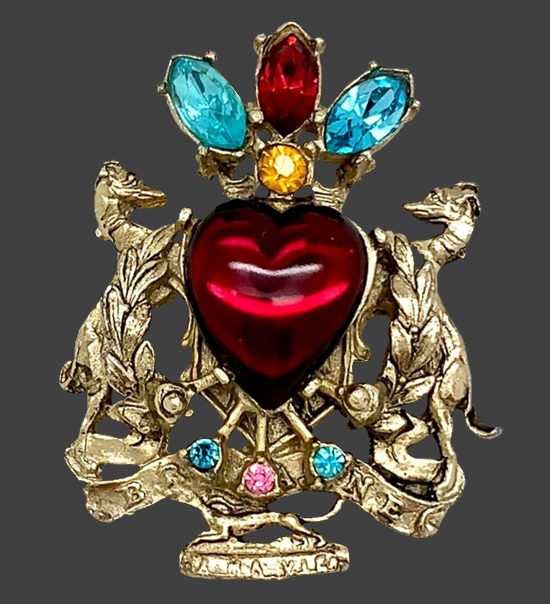
Heraldic Heart shield dogs crown gold tone rhinestone brooch. Cohn Rosenberger Coro Jewelry History

The most iconic jewelry brand of the 20th century, Cohn & Rosenberger, or Coro began its history in 1903.

Emanuel Cohn (1858 – 1910) first started in the jewelry business in 1876 as a traveling salesman for Newwitter & Rosenheim. He was later connected with Heilbronner, Brandt & Stern for about a year and a half. Then, he went into business for himself under the firm style of Stern, Cohn & Co on January 1, 1898.

In January, 1899, Stern withdrew and Emanuel Cohn admitted Nathan Cohn, when the style of E. Cohn & Co was assumed. On January 1, 1901, Carl Rosenberger (1872 – 1957) joined the firm as a partner. Born in Germany, Rosenberger came to the USA in 1886. He began his career as a jewelry salesman for Fishel, Nessler & Co. When Nathan Cohn withdrew January 1, 1903, the firm changed the name to Cohn & Rosenberger.
(more…)

Noted American Jewelry Designer Clifford Furst

Noted American Jewelry Designer Clifford Furst
Lobster gold plated enamel rhinestone brooch pin by Castlecliff. Noted American Jewelry Designer Clifford Furst

The history of Castlecliff jewelry brand began in 1925 when Clifford A Furst (1895-1958) made his first jewelry piece. A marine engineer by profession and an artist by vocation, he created a pair of shoe buckles. Furst and his partner, jewelry designer Joseph A. Bobley founded The Castlecliff Co., 366 Fifth Avenue, New York City, in 1925.

In 1945, Furst and Bobley registered wordmark Castlecliff in Canada. Eight years later Joseph A. Bobley (1900 – 1995) started his own business Joseph Bobley Jewelry Inc., 40 West 37th Street, New York.
(more…)