Renowned Danish Silversmith Georg Jensen

Born in the Danish village of Raadvad, Georg Jensen (1866 – 1935) was a prominent silversmith, artist, sculptor and ceramist. He graduated from a technical school and became an apprentice in 1884. He later attended the Royal Academy of Arts in Copenhagen and qualified as a sculptor in 1892.
In 1904, Georg Jensen opened his own workshop at Bredgade 36 in Copenhagen, taking with him one apprentice, Henry Pilstrup. The equipment in the workshop was very primitive. There were no machines. All work, including drilling holes, they did by hand.
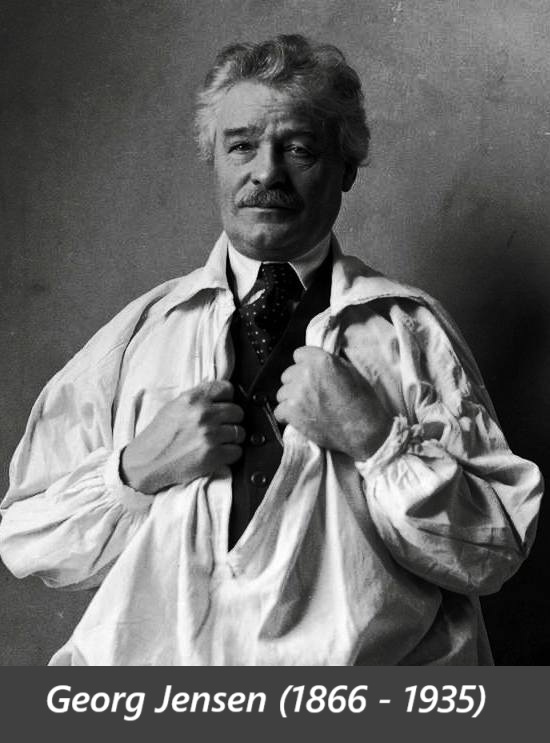
As Georg Jensen’s work became known throughout Denmark and then in Europe and the United States, other jewellers, silversmiths and goldsmiths, as well as young apprentices, began to come to him. Among them were Henry Pilstrup, Marius Thomassen, Holger Bremer, Johan Rohde, Harald Nielsen, and Gustav Pedersen who worked for the firm for many years.
Collaboration with other designers became an important part of Georg Jensen’s work and laid the foundation for the continuity of traditions. Jensen had a talent not only for design and metalworking, but also for the ability to gather the right people around him.
Jensen Jewelry in Museums
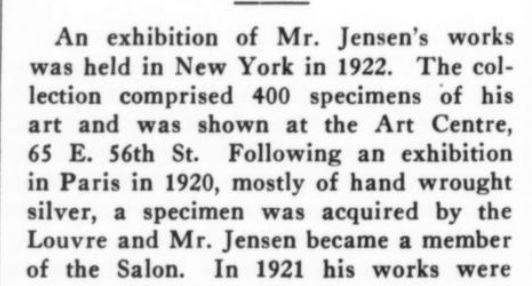
In the early 1920s, the permanent display of Jensen gold and silverware was located at 159 W. 57th St., New York. Frederik Lunning (1881-1952) represented Jensen firm in the USA. Following the lead of the Louvre in Paris, and many European museums, the Metropolitan Museum of Art, Detroit, Cleveland and Boston Museums purchased specimens of the Jensen silver for their permanent exhibitions.
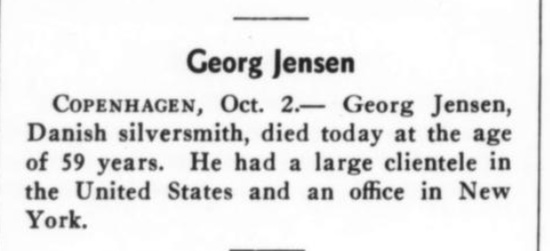
After the death of Jensen in 1935, Harald Nielsen took over the management of the workshops. An outstanding designer, Harald Nielsen worked hand in hand with Georg Jensen for many years. Under his leadership, about two hundred skilled blacksmiths, forty-five apprentices and seventy-five laborers brought the founder’s vision to life.
Second generation of Jensen jewelers
Apprentices were basic in carrying on this silver work for Jensen. The Jensen craftsmen taught them to draw, grind, polish, spin, model, and other skills. The most important criterion for acceptance was ability to draw.
The second generation of Jensen jewelers included sons of the founder, Jorgen Jensen and Séren Jensen. Also, Sigvard Bernadotte, and all of them continued the tradition each in his own way. A third group of younger designers included Danish-born architect Magnus Stephensen, sculptor Ib Bluitgen, and silversmith Henning Koppel. Koppel joined the firm of Jensen in 1945.
Royal Copenhagen purchased Jensen Silver corporation in 1973, and merged with other companies in the mid 1980s. In the following years, Jensen’s company changed owners several times, most recently in 2023.

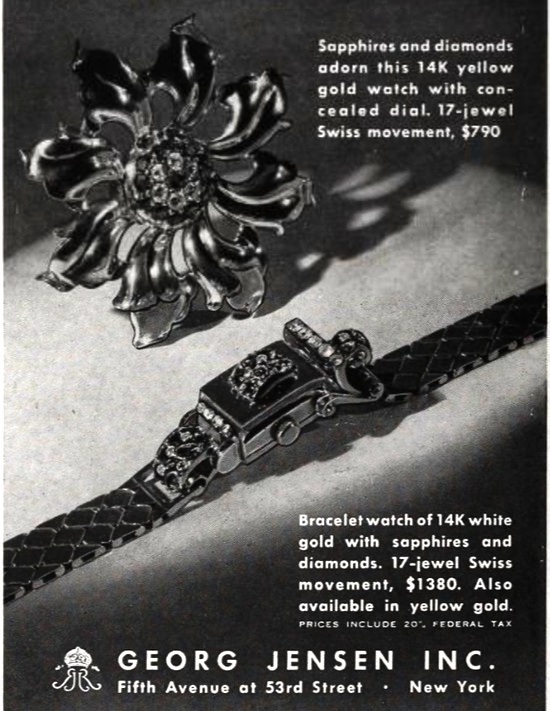
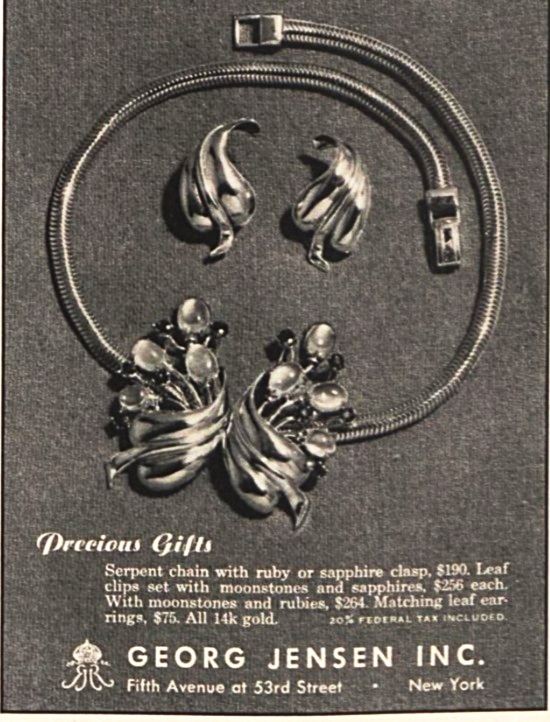
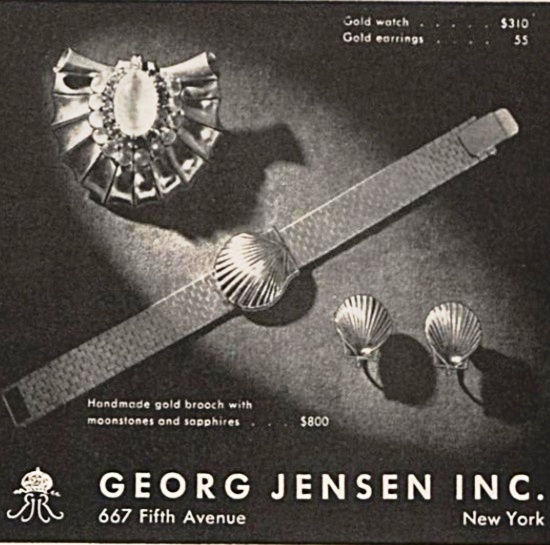
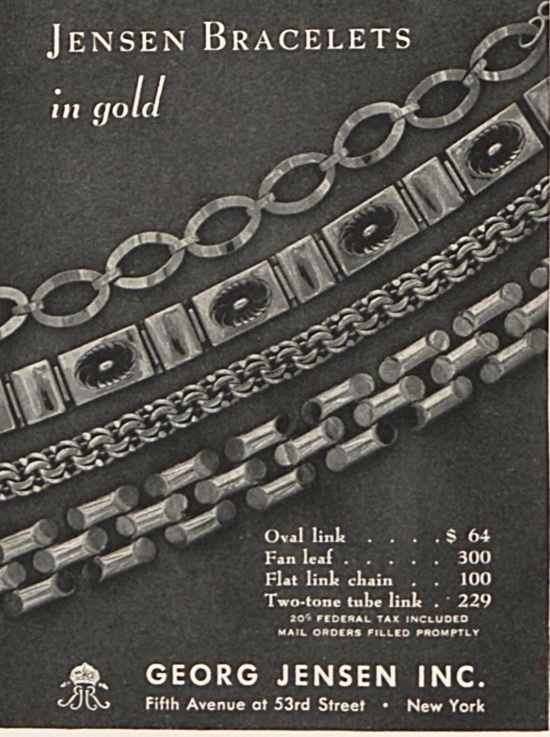
Georg Jensen Vintage Jewelry