Stephen Lane Folger Jewelry Company History
Born in Bergen County of New Jersey, Stephen Lane Folger (December 27, 1868 – August 28, 1930) was pioneer emblem and medal manufacturer and head of the firm bearing his name. He established Stephen Lane Folger company at 200 Broadway, New York in 1892.
In March 1902 Stephen Lane Folger moved his firm to 180 Broadway, New York. Stephen L. Folger company was known as manufacturer of fraternity jewelry, club and college pins and rings, gold, silver and bronze medals. Since the beginning, Stephen Lane Folger actively advertised his products in various educational and professional journals.

In July 1916 Stephen Lane Folger obtained a charter of incorporation at Albany, N. Y., authorizing the concern to deal in watches, diamonds, and jewelry, with a capital of $100,000. The incorporators were Stephen Lane Folger, his wife Bertha B. Folger, and John Franklin Moult.

John Franklin Moult
In 1898 John Franklin Moult (1876 – 1943) joined the firm of Folger, having gone through all the stages of work during 45 years in the company. He began as a salesperson, then secretary, vice-president and president. He took over Stephen L. Folger, Inc. in 1930, and was active until his death in 1943.

The Folger brothers
Meanwhile, the Folger brothers were well-known New York businessmen, each in his own field. Thus, Stephen Folger’s elder brother, Henry Clay Folger (1857 – 1930), was the president of an oil company. A collector of Shakespeareana, Henry Clay Folger founded the Folger Shakespeare Library in Washington, DC in 1930. Noteworthy, both brothers died in the same year.

Stephen Lane Folger Jewelry Company History

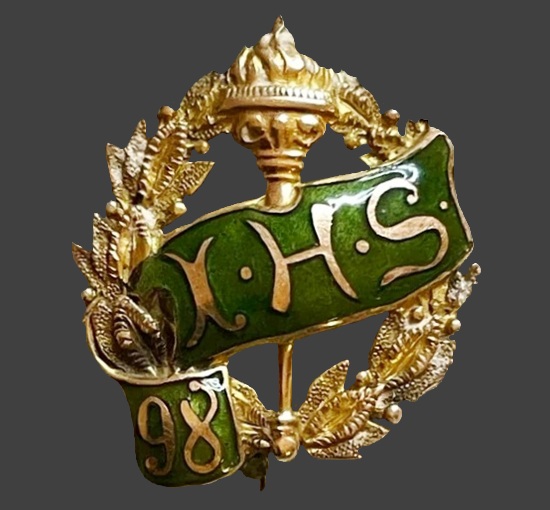
Handcrafting pins bearing the certain inscription, Folger jewelers used gold, silver and multicolor enamel. They traditionally signed their jewelry pieces with S.L.F. NY, Folger N.Y., or Folger B’Way NY and and the karat weight of gold. Yet, the oldest signature of the firm included one letter “F”.

Renewed in 1969 The Stephen Lane Folger corporation ceased to exist in 1993.